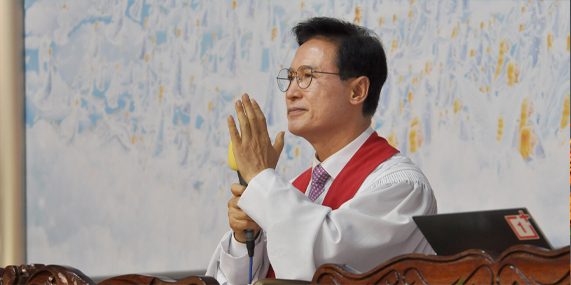
An Increasingly Beautiful Life
Bible passage: 1 Samuel 2:22-26
“Now Eli, who was very old, heard about everything his sons were doing to all Israel and how they slept with the women who served at the entrance to the Tent of Meeting. 23. So he said to them, "Why do you do such things? I hear from all the people about these wicked deeds of yours. 24. No, my sons; it is not a good report that I hear spreading among the LORD's people. 25. If a man sins against another man, God may mediate for him; but if a man sins against the LORD, who will intercede for him?" His sons, however, did not listen to their father's rebuke, for it was the LORD's will to put them to death. 26. And the boy Samuel continued to grow in stature and in favor with the LORD and with men.”
Today’s scripture introduces two types of people who lived in the same era and served in the same temple. They were all young people.
One was Samuel, the son of Hannah, and the others were the two sons of Eli the priest, 'Hophni' and 'Phinehas.' Although the Bible does not provide their exact ages, Samuel was likely a teenager. Today's scripture refers to him as a 'boy.' On the other hand, Eli's two sons, given that they committed sinful acts even before marriage, were likely older, falling into the category of young adults rather than boys. In verse 22, Eli rebukes his sons, but they do not listen to him. After verse 25, however, Samuel is described in this way: 1 Samuel 2:26 says, “And the boy Samuel continued to grow in stature and in favor with the LORD and with people.”
This passage is precious because the word ‘favor’ here in Hebrew is 'tov.' In English, it means good or beautiful. The first person to use this word in the Bible was God Himself. In Genesis Chapter 1, as God created the heavens and the earth, He looked at the world He had made each day and said, "God saw that it was good." The word 'good' here is 'tov' in Hebrew - God’s expression of admiration. Amazingly, the boy Samuel was 'tov' in the sight of God. Samuel was a 'good' and 'beautiful life' in the eyes of God. However, during the same time, Eli's two sons, who lived in the same temple, were living 'disgraceful lives.' Consequently, God decided to take their lives. In the latter part of verse 25, it says that God was determined to put them to death. This concerns me. In the same era, in the same church, some young people live 'beautiful lives' in the sight of God, while others may live 'disgraceful lives.' How heartbreaking is this?
I sincerely hope that all the teenagers attending our church will live 'beautiful lives' blessed by God, like Samuel, through this devotional service. Moreover, I hope that all the believers, not only from this church but also from the branch sanctuaries participating in today’s service, will live lives that are ‘good’ in the sight of God, just like Samuel - a 'beautiful life' in the eyes of God. I would greatly appreciate it if you could bless those next to you on behalf of the Lord by saying, "You are truly a beautiful person," or "You are truly a good person in the eyes of God." I’m so envious that Samuel was evaluated as a 'truly beautiful life' by God.
If you carefully examine today’s scripture, you will find a particularly moving part. Let’s take another look at verse 26: It says, “And the boy Samuel continued to grow in stature and in favor with the LORD and with people.” Samuel received the evaluation of being a 'beautiful life' from God. But what’s even more important here is the phrase 'continued to grow.' The phrase 'continued to grow in favor' means 'a life that becomes increasingly beautiful.' It means a life that becomes more beautiful and better as time goes on. I hope you will have the same dream as Samuel: a life that becomes more beautiful tomorrow than it is today, a life that becomes more beautiful the day after tomorrow than it will be tomorrow. Our 'spirit,' our 'character,' our 'heart' should grow more beautiful with time, so that we are recognized for this beauty before both people and God.
I believe that my 20s were more beautiful than my teens, my 30s were more beautiful than my 20s, my 40s were more beautiful than my 30s, my 50s were more beautiful than my 40s, my 60s were more beautiful than my 50s, and I believe that now, I am even more beautiful and attractive. I’m not talking about physical appearance, but rather, in a spiritual sense, and from the perspective of the heart. I hope that all of you will become children of the Lord, whose 'spirit' and 'heart' grow more beautiful until the day you enter the Lord’s kingdom. So, how did Samuel receive the evaluation of living an 'increasingly beautiful life'?
1. To live an increasingly beautiful life, your relationship with God must be 'a living relationship.' If you read 1 Samuel Chapters 2 and 3, which record Samuel’s childhood, you will find common phrases used to describe the young Samuel. 1 Samuel 2:18 says, “But Samuel was ministering before the LORD. ” 1 Samuel 2:21b says, “Meanwhile, the boy Samuel grew up in the presence of the LORD. ” 1 Samuel 3:19 says, “The LORD was with Samuel as he grew up…..” 1 Samuel 3:21 says, “The LORD continued to appear at Shiloh, and there He revealed Himself to Samuel through His word.” The phrases used to describe the young Samuel, such as 'ministering before the LORD,' 'grew up in the presence of the LORD,' 'the LORD was with him,' and 'the LORD continued to appear and reveal Himself,' all imply that Samuel had a living, vibrant, and genuine relationship with God from his childhood or boyhood. Unlike those who claim to believe in God with their words but live lives disconnected from Him, Samuel’s relationship with God was alive and real, influencing and being influenced by Him. On the other hand, Eli’s sons lived lives disconnected from God. Although they lived in the same temple as Samuel and their father was responsible for that temple, their lives were completely unrelated to God. In this context, one can find an insightful comparison in 1 Samuel Chapter 2 and Chapter 3.
The lives of Samuel and Eli’s two sons are contrasted with each other. 1 Samuel 2:11 says, “…the boy ministered before the Lord,” and in the very next verse, verse 12, it says, “Now the sons of Eli were worthless men; they did not know the LORD.” In 1 Samuel 2:17 says, “This sin of the young men was very great in the LORD’s sight, for they were treating the LORD’s offering with contempt.” Then, in the very next verse, verse 18, in contrast, it says, “But Samuel was ministering before the Lord.” In 1 Samuel 2:21, “…the boy Samuel grew up in the presence of the Lord,” and in verse 22, Eli’s two sons are seen committing abominable sins.
The Bible records Samuel and Eli’s two sons, Hophni and Phinehas, in comparison, showing that Samuel’s life grew increasingly 'good' and 'beautiful,' while the lives of Eli’s sons grew increasingly wicked. In the end, Eli’s two sons even slept with the women who served at the entrance to the Tent of Meeting. What was the outcome of these wicked sons? 1 Samuel 4:11 says, “The ark of God was captured, and Eli’s two sons, Hophni and Phinehas, died.” Eli’s sons walked a path of miserable destruction, and now they must be suffering in the lower grave. However, even after thousands of years, Samuel, who lived a beautiful life, is still someone we want to resemble and follow. Now, he is happily dwelling with God in New Jerusalem. I sincerely hope that teenagers will never walk the path of Eli’s sons, Hophni and Phinehas. I hope you do not become people who grow increasingly disgraceful or repulsive. Occasionally, when I meet former servants of the Lord who have left Manmin Central Church, I feel a heavy heart. Some are no longer pastoring and are working secular jobs, while others are wandering, unable to find their spiritual bearings. From this perspective, I consider myself truly fortunate. I am increasingly filled with the Holy Spirit as I preach the gospel of sanctification.
I can continue to pastor while sharing God’s love and the grace of the Lord with wonderful believers like you. I feel as if I am following in the footsteps of Samuel’s increasingly beautiful life, and I am deeply grateful for this. I hope the teenagers who are dedicating themselves in today’s service will not follow the paths of Eli’s two sons, but rather follow the life trajectory of Samuel, living lives that become increasingly beautiful. To do this, your relationship with God must be a living, vibrant, and genuine relationship. You must be students who pray. Although you should excel in your school studies, you must also read the Bible, learn God’s Word, and live according to it. You must be teenagers who seek God in your daily lives. When your grades drop, when you suddenly face difficulties, when your friendships become strained - don’t despair or give up. Instead, seek God, meet Him, and receive His help so that your life is restored. I hope your relationship with God becomes a living and dynamic one.
2. To live an increasingly beautiful life, there must be true devotion of both body and heart to God. 5 In 1 Samuel 1:11, we see Samuel’s mother, Hannah, offering a vow in prayer to God by saying like: “If You will give Your servant a son, then I will give him to the LORD for all the days of his life.” And in 1 Samuel 2:28, as she had vowed, she goes up to the temple and dedicates Samuel to God: It says, “…“So now I give him to the LORD. For his whole life he will be given over to the LORD.” And he worshiped the LORD there.”
This is the true spirit of a devotion service. Samuel devoted his entire life to God, not living according to the ways of the world, but dwelling in the temple, focusing solely on God’s Word and prayer throughout his life. He dedicated both his body and heart entirely to God. But what about Eli’s two sons? Although their bodies resided in the temple because they were sons of the priest, their hearts were set on the world. In 1 Samuel 2:12 and following verses, we see that they abused their status as the priest’s sons to commit acts more wicked than those of worldly people, eventually even committing sexual sins. For our lives to become increasingly beautiful, we must not follow the ways of the world but instead dedicate our bodies and hearts to God, focusing solely on Him in our life of faith.
Therefore, the teenagers participating in this devotional service should not only participate in the service but also make a 'Devotion Proclamation.' What is a 'Devotion Proclamation'? Let me explain using the words from Exodus 7:16. It says, “Then say to him, ‘The LORD, the God of the Hebrews, has sent me to say to you: Let My people go, so that they may worship Me in the wilderness. But until now you have not listened.” At this time, the Israelites were being oppressed as slaves in Egypt. God instructed Moses to proclaim to Pharaoh, the king of Egypt, who was oppressing God’s people, the Israelites: “Let My people go.” This is a proclamation that God’s people cannot remain oppressed by Egypt, a foreign land, but must leave the evil land to serve only God.
To the teenagers, I want to appeal to you: With this scripture in mind, proclaim to the world that tempts you as follows: “I will no longer be led by it. I will no longer be led by this world.” Proclaim this. This is a Devotion Proclamation. Today’s devotion service is not just about sitting and listening to the Word; it’s about making a proclamation. How important is this proclamation? Consider the story of Daniel, who started as a pitiful captive but later rose to become a great politician. How did he transform into such a great leader? Do you know what the first step was? The first step was a proclamation. In Daniel 1:8, it says: “But Daniel resolved not to defile himself with the royal food and wine, and he asked the chief official for permission not to defile himself this way.” This great proclamation was the starting point that led to his greatness. In John Chapter 11, after Jesus resurrected Lazarus, who had been dead for four days, He said in verse 44, “Take off the grave clothes and let him go.” This was a command to release Lazarus from the power of death, so he would no longer be bound by it. How full of the power of death is this world today?
It is filled with corruption, immorality, lies, and deceit. How many people are bound by these worldly trends? They must not remain bound; they must be set free. The sexual immorality in America has gone to such extremes. There was a high school girl pushing a baby pushchair, and someone remarked, “Your niece is cute.” But the girl replied, “She’s not my niece, she’s my daughter.” Why is a high school student bringing a baby to school? Some American high schools have daycare facilities to care for the babies of unwed mothers. There is no guarantee that this won’t happen in our country. The corrupt sexual influences from America and Europe continue to flow into our society. Raising children in a faith-filled home is incredibly challenging. When parents try to correct their children, they often hear the response: “All the other kids are doing this; why can’t I?” Children question why they are being singled out when everyone else is living this way.
There is another monster that torments our children - internet addiction, smartphone addiction, and various other forms of addiction are becoming serious problems. It is said that 29.3% of the youth population is at risk of over-dependence on the internet or smartphones. Nearly 3 out of 10 teenagers show signs of addiction. The term 'at-risk group for over-dependence' refers to those who are excessively dependent on the internet or smartphones, falling into addiction. Many experts are concerned about the harmful effects of media addiction. It can lead to attention deficit, anger control issues, impulse control deficiencies, and a tendency to forget reality. When impulses arise, they can’t be controlled. Why do we hear so much about drug use nowadays, something that was unimaginable in the past? In such times, what should we do? We must make a 'Devotion Proclamation.' There was a list of the top 10 university slogans selected by the Internet. They chose 10 universities with the most inspiring slogans. Let me share a few. The slogan for K University is also impressive: “Bet your youth on K University, and K University will bet the world on you.”
How inspiring is that? How wonderful it would be for young people to study with such a slogan in mind! H University’s slogan is, “Being unique and different makes me awesome.” This seems like a slogan that we Christians should adopt. Let’s all shout H University’s slogan together: “Being unique and different makes ” me awesome. When everyone in college is drinking and partying, you can say, “I’m a Christian. My father didn’t drink, and I don’t drink either.” Proclaim, “Different, therefore cool.” Even in an era when it’s common to come home late at night, you can decide to come home by 7 PM, have dinner with your parents, and talk with them. Proclaim, “Being unique and different makes me awesome. ” So, let’s shout together as in Exodus 7:16; “Let me go; I will no longer be led by your temptations.” Let’s proclaim to the world, “I will no longer be led by temptation.
I will no longer be swayed by your temptations. Let me go, for I am a child of God.” I hope that this 'Devotion Proclamation' will frequently flow from the lips of the teenagers participating in today’s devotional service.
3. To live an increasingly beautiful life, you must be influenced by the Word of God 1 Samuel 3:1 says, “The boy Samuel ministered before the LORD under Eli. In those days the word of the LORD was rare; there were not many visions.” This verse describes the times they were living in: "The word of the LORD was rare; there were not many visions." The Word was scarce, and people could not hear it. In contrast, when describing Samuel, we see a different picture. The LORD revealed Himself to Samuel through His word. 1 Samuel 3:21 says, “The LORD continued to appear at Shiloh, and there He revealed Himself to Samuel through His word.” While that era was marked by the scarcity of the Word so much so that people could not hear it, Eli’s two sons lived during a time when the Word was not heard, followed the ways of the world, committed great sins, and ultimately led 'increasingly disgraceful lives.'
However, young Samuel, who lived in the same era, received the grace of hearing and seeing the Word of God and lived according to it, enabling him to live an 'increasingly beautiful life.' In our current time, because the Word is not often heard, many Christians are influenced by this and do not know the Word. In Samuel’s time, before the Bible was fully available, how much more would people have longed for and awaited God’s Word? However, in our time, we have the Bible, the revealed Word of God. We live in a time when we can read and hear God’s Word anytime, whether in the morning, evening, or when feeling down. The problem is that people are not reading it. If you want to live an increasingly beautiful life like Samuel, you need to draw close to the Word.
No Bible, No breakfast. When I was in Korea during a student retreat, we had to memorize Bible verses to eat. Yesterday, our teenagers had milk tea and chapati and chicken, but did they recite Bible verses before eating? Or did they only nourish their bodies? The fact that our times are becoming more desolate and that more disgraceful people are emerging may be due to the loss of the Word. Isn’t this the fundamental reason many Christians are losing their beauty? I know of a father who made his child memorize a Bible verse before they could eat. He would say, “If you feel hunger in your body and seek food, why don’t you also feed your soul with the Bible?” This is why "No Bible, No breakfast" is necessary. In our church, since we memorize one verse every day, starting tonight, only if your children memorize the scripture from the bulletin, then give them their meal. We must hold on to the Word that centers our lives. People often say, "I am the master of my life, so I will live as I please," but life doesn’t work out that way. When you obey the Word, your life is centered, and you can walk the right path.
4. To live an increasingly beautiful life, you must have self-control Samuel was able to live an 'increasingly beautiful life' because he had self-control. Eli’s two sons, on the other hand, lacked self-control. They lived recklessly, like wild horses that had broken free of their reins, doing whatever they pleased. The famous French novelist Victor Hugo once said that there are three battles in life: first, the battle between humans and nature; second, the battle between humans and other humans; and third, the battle within oneself. Among these, the battle within oneself is the most important. The person who can conquer themselves is the strongest. If you can conquer yourself, you can easily overcome any other difficulties. Proverbs 16:32 says, “Better a patient person than a warrior, one with self-control than one who takes a city.” So, how can we win the battle within ourselves? 1 Corinthians 9:25 says, “Everyone who competes in the games goes into strict training. They do it to get a crown that will not last, but we do it to get a crown that will last forever.”
An athlete competing for a gold medal cannot win if they lack self-control. The word for self-control in Greek is "enkrateuomai," which means "to conquer oneself." In English, it is "self-control," referring to the ability to properly regulate oneself. When thinking, speaking, expressing emotions, or acting, it’s not about doing whatever you want but rather considering the consequences before acting. To win the battle within yourself, you must have self-control. This means suppressing temporary impulses or desires and exercising patience to achieve better results or greater satisfaction. Research has shown that there is a significant difference between children with self-control and those without it. At Stanford University in the United States, a "marshmallow experiment" was conducted on children. Marshmallows are soft candies that Americans enjoy eating. In the experiment, 653 children were each given a sweet marshmallow and told that if they could resist eating it for 15 minutes, they would receive another marshmallow as a reward.
One-third of the children couldn’t wait the 15 minutes and ate the marshmallow, while two-thirds waited and received the reward. Fifteen years later, the children who had resisted the temptation of the marshmallow had grown into young adults with strong self-control and social skills. They excelled academically and had no issues with obesity, drug addiction, or social maladjustment. In contrast, the children who quickly ate the marshmallow were more prone to irritability and often got into petty fights. There was also a significant difference in academic performance between the two groups. The group that waited had significantly higher scores on college entrance exams than the group that ate the marshmallow immediately. People with high self-control are said to have higher self-esteem, stronger perseverance, are less likely to succumb to temptations, have better relationships, are more adaptable, and achieve more in life. Children who lack self-control are more likely to fall into alcoholism and drug addiction, face financial difficulties, work in relatively low-paying jobs, and over 40% of them eventually receive criminal convictions and end up in prison. To develop strong self-control, you must have a living relationship with God, as Samuel did. You must resist looking to the world, remain steady, proclaim "let me go," and resist the temptations of the world.
Conclusion Samuel and Eli’s two sons, Hophni and Phinehas, lived in the same era and the same temple, but their lives were entirely different. Their life paths were completely opposite. Samuel’s life became increasingly beautiful, while Hophni and Phinehas’ lives became increasingly disgraceful. To live an increasingly beautiful life in the sight of God, like Samuel, we must first have a living relationship with God.
Second, we must stand firm and proclaim to the world, “Let me go,” without being swayed to the left or right. Third, we must be lives influenced by the Word of God and develop strong self- control. May you become like Samuel, increasingly recognized, loved, and living an 'increasingly beautiful life, ' in the name of our Lord Jesus Christ I pray. - END -